
Temirlan-Oil Refinery Project
A High-Capacity Refining Complex in the “Maymak” Free Economic Zone
Overview & Market Background
The Kyrgyz Republic has been experiencing a prolonged shortage of refined petroleum products. Following the general economic downturn and specifically in the oil sector, this Central Asian country entered the new millennium demonstrating stable growth in demand for petroleum products (about 10% per year). However, the complexity arises because the growing demand is not matched by an equivalent increase in supply.
Over the past 15 years, several new refineries have been built in the Kyrgyz Republic, but there have been no qualitative changes in the market. Despite these additions, the situation remains tight.
Main Problem
All Kyrgyz refineries are located far from crude oil production sites and pipeline routes, and the Kyrgyz Republic's own extractable oil reserves are minimal—insufficient to meet the continuously growing demand. The total refining capacity of the country far exceeds the actual output. The five active Kyrgyz refineries—"Junda" (800,000 t/yr), Tokmok (450,000 t/yr), Kant (300,000 t/yr), "Kyrgyz Petroleum" (300,000 t/yr), and Jalal-Abad (60,000 t/yr)—have a combined capacity nearly 15 times larger than their current production. This mismatch is primarily because of the distances from crude sources and pipeline infrastructure.
Even the existing production capacities do not meet modern standards. Refining depth and product quality are concerning. As the Kyrgyz Republic expanded its nominal refining capacity, the proportion of gasoline and diesel output declined. In 2000, gasoline accounted for over half of total output; currently, about 54% is heavy fuel oil (mazut).
Consequently, the Kyrgyz Republic faces a severe deficit in fuel and lubricants, despite having several refineries. All existing facilities operate below 10% capacity because they lack direct pipeline connections for crude supply and must rely on rail, artificially increasing both raw material and final product costs.
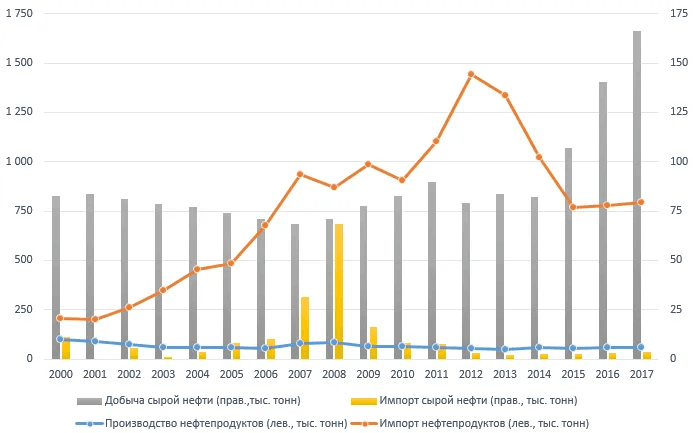
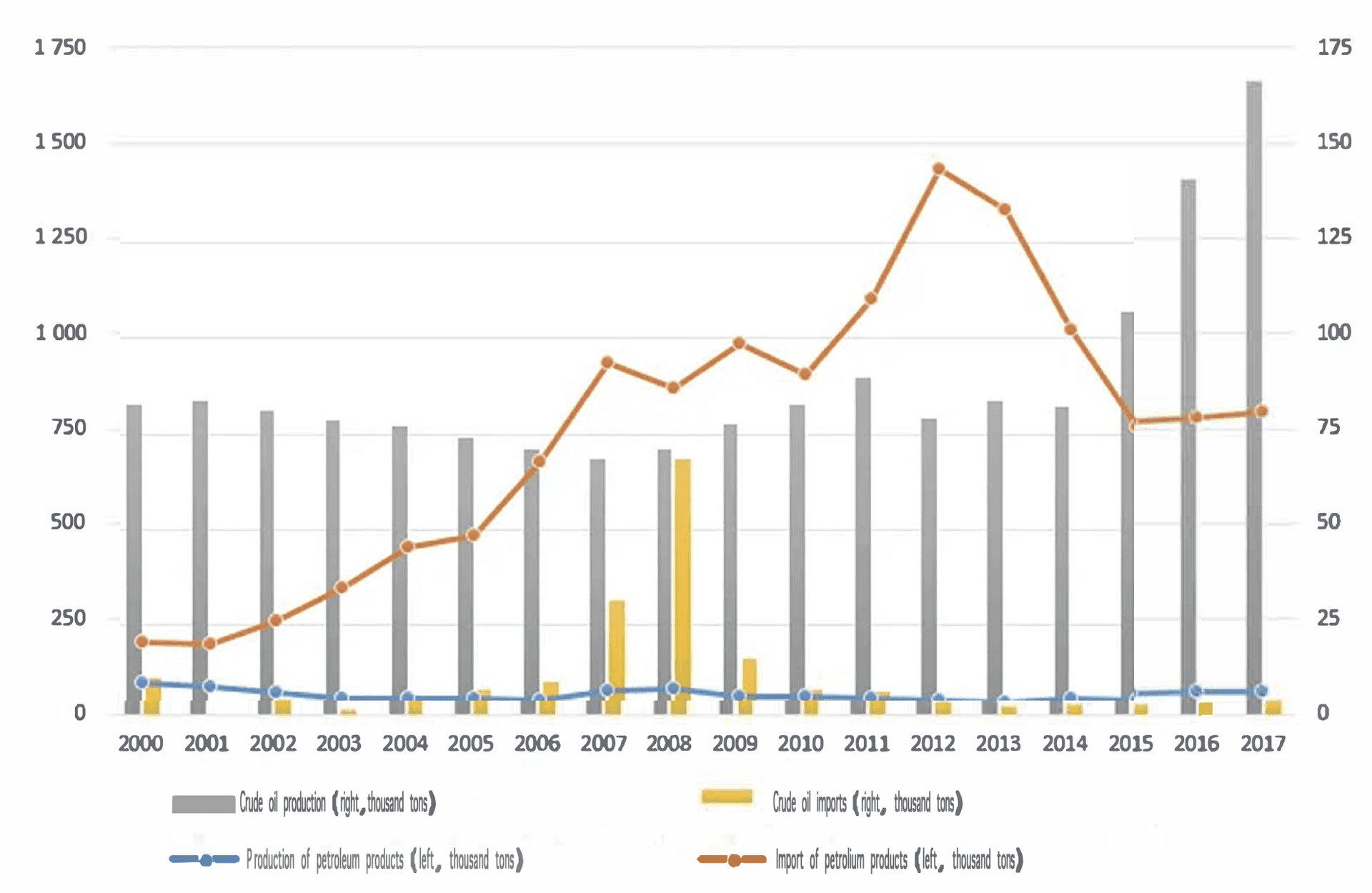
Statistical Charts (2000–2017)
Below are two charts showing crude oil production & imports, alongside petroleum product production & imports in the Kyrgyz Republic from 2000 to 2017.
Source: National Statistical Committee of the Kyrgyz Republic.
Project Financing Framework
A credit agreement has been signed in connection with the project.
Formation of the Kazakh–Kyrgyz Commission & the “Maymak” FEZ
A Kazakh–Kyrgyz intergovernmental commission was established to support cross-border industrial cooperation, with Mr. M. D. Orazbayev (General Director of Temirlan-Oil) as one of the key initiators. This institutional work contributed to the project framework and to the creation of the “Maymak” Free Economic Zone (FEZ) in Kara-Buura District of Talas Region.
By a government decree of the Kyrgyz Republic, Temirlan-Oil was tasked with developing the “Maymak” FEZ, allocating specific areas for an oil refinery, a petrochemical plant, a gold mining enterprise, and an agro-industrial complex.
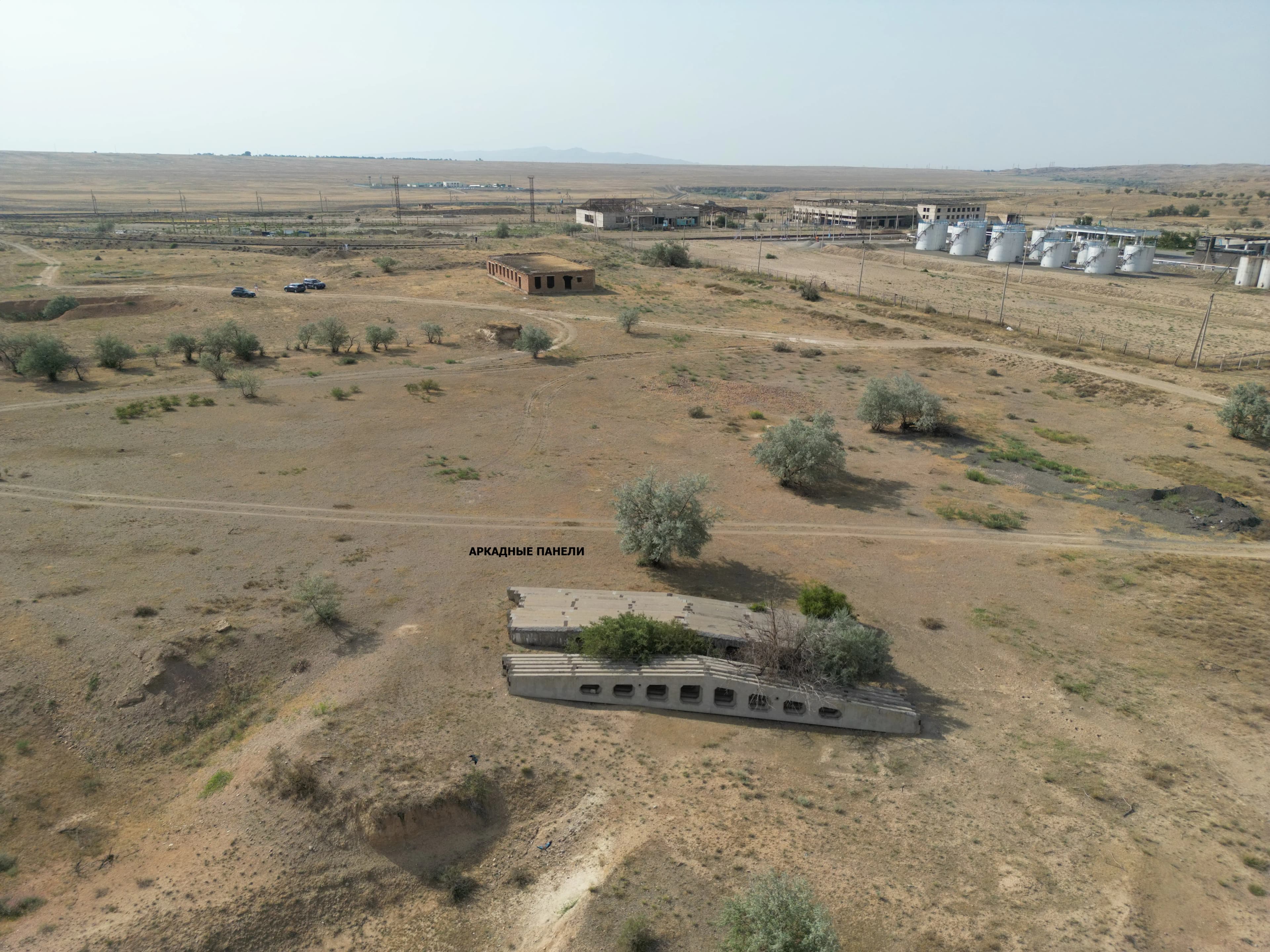
As part of the first phase of the “Maymak” FEZ development plan—constructing the oil refinery—Temirlan-Oil completed all required architectural and planning documentation with the relevant government agencies, built an oil storage facility on the designated land, established the necessary infrastructure, and carried out earthworks up to the main pipeline tie-in point.
Temirlan-Oil also reached agreements with the German government to participate in the “Maymak” FEZ project via a local manufacturer financing program. Under these agreements, German manufacturers are designated as primary equipment suppliers for all development phases of the FEZ, while Euler Hermes Germany is the lead project finance arranger and risk insurer. The German partner, "Temirlan Development GmbH", supports international coordination of the project financing program.
Feedstock & Logistics Concept
The project is designed to assess regional crude-feedstock options and the logistics required for refinery operations. Potential sources and transport solutions are reviewed within the project’s technical and contractual workstreams.
Source identities, volumes, routes, quality parameters and commercial terms are transaction-specific and are not presented here as confirmed public arrangements.
Offtake & Domestic Market
Temirlan-Oil's commercial activities may include the sale of diesel fuel and other petroleum products, subject to product availability, applicable approvals and separate transaction-specific agreements. This website does not represent continuous availability or guaranteed supply.
The Kyrgyz Republic currently has several refineries for processing hydrocarbons into fuel. These include LLC "Kyrgyz Petroleum Company" in Jalal-Abad (300 thousand t/yr), "Russneft" at the refinery in Kant (250 thousand t/yr), and LLC "China Petrol Company Junda" in Kara-Balta (800 thousand t/yr nominal, ~80 thousand t/yr actual). All of them lack reliable crude supply and operate below capacity. Petroleum products (fuel) are therefore imported from Kazakhstan and Russia. In 2014, the Kyrgyz Republic's domestic annual demand was about 3.5 million tons of light petroleum products and 650 thousand tons of heavy petroleum products.
Insurance & Project Implementation
Insurance and risk-management solutions for the project are structured with the involvement of leading international insurance providers. Highly professional specialists and technologists from Russia, Kazakhstan, and Germany have been engaged in project design and implementation.
Under the agreement, the Kyrgyzgiprostroy Design Institute, an open joint-stock company in the Kyrgyz Republic, will act as the general designer. Subcontracting work will be carried out by international engineering companies. The supply and turnkey installation of technological equipment is expected to involve German manufacturers and specialized engineering partners.
German equipment was selected because the technology can be reconfigured for any feedstock parameters across a broad spectrum, as well as adapted to produce various final products. Hence, the refinery can be supplied from multiple crude sources. In case of unforeseen circumstances, complete logistics for the supply of alternative feedstock have been developed for the plant. The necessary infrastructure to accommodate rail deliveries is already in place.
Project Technical & Financial Details
| Company & Project | |
|---|---|
| Company Name | Open Joint-Stock Company “Trading and Industrial Company ‘Temirlan-Oil’” |
| Date of Re-registration | May 12, 1998 |
| Type of Company | Open Joint-Stock Company |
| Industry | Oil Refining |
| Founders / Shareholders | M. D. Orazbayev – 100% |
| Project Location | Free Economic Zone “Maimak”, Kyrgyz Republic |
| Project Status | Development / Investment Screening. Final technical, EPC and financing parameters remain subject to FEED, contracting and lender confirmation. |
| Capacity & Ramp-up | |
| Projected Refining Capacity | 3,500,000 tonnes per year — current financial-model working case |
| Ramp-up Profile | 70% / 90% / 100% of design capacity during the initial operating ramp-up period |
| Capital Cost | |
| Plant CAPEX | Approx. US$1,225.6 million |
| Process Equipment | Approx. US$827.5 million |
| Offsites, Tankage & Utilities | Approx. US$144.3 million |
| Crude Pipeline & Refinery Tie-in | Approx. US$19.8 million |
| External Power Connection | Approx. US$16.5 million |
| Auxiliary Equipment | Approx. US$3.8 million |
| Engineering & Project Delivery | Approx. US$101.3 million |
| Contingency | 10% — current management screening case |
| Other Site Facilities | Approx. US$1.1 million |
| Funding & Financing | |
| Gross Project Funding Requirement | Approx. US$1,373.5 million, before financing costs |
| Current Financing Structure — Model Case | 100% core senior debt / 0% core equity |
| Core Senior Term Commitment | Approx. US$1,304.6 million |
| Capitalized Interest During Construction | Approx. US$111.0 million |
| Senior Term Debt at COD | Approx. US$1,415.6 million |
| Working-Capital Facility at Start of Operations | Approx. US$68.9 million |
| Total Senior Exposure at COD | Approx. US$1,484.5 million |
| Financing Rate — Current Model Case | SOFR + 2.0% margin; current model reference all-in rate approximately 5.64% |
| Upfront Fee | 1.0% of the senior term commitment |
| Commitment Fee | 0.5% per annum on the undrawn committed amount |
| Loan Period | 12 years — current financial-model assumption |
| Grace Period | 3 years |
| Debt Service Reserve | 6 months of scheduled debt service |
| Target Debt Service Coverage Ratio | 1.35x |
| Operating & Financial Performance | |
| First Full-Capacity Operating Year | 2030 — current financial-model case |
| Revenue — First Full-Capacity Year | Approx. US$2,446.2 million |
| Cash Cost of Goods Sold — First Full-Capacity Year | Approx. US$1,941.3 million |
| Gross Operating Profit — First Full-Capacity Year | Approx. US$504.9 million |
| EBITDA — First Full-Capacity Year | Approx. US$446.2 million |
| Project Payback | 2031, approximately 5 years from the start of the financial-model horizon |
| Discounted Payback | 2033 |
| Project Discount Rate / WACC | Approx. 9.68% |
| Project NPV | Approx. US$1.10 billion on the 2026–2042 project horizon |
| Project IRR | Approx. 21.7% |
| Commercial & Implementation | |
| Sales Allocation — Current Model Case | 30% Kyrgyz Republic / 70% export markets |
| Product Sales Basis | FCA / ex-refinery Maimak; onward transportation from the refinery is borne by the buyer |
| Target Markets | Kyrgyz Republic and selected regional export markets, including Uzbekistan and Afghanistan; other regional markets remain subject to commercial validation |
| Planned Staffing | Approx. 320 employees in the current financial-model screening case; subject to final operating organization and staffing plan |
| Planned Products | Gasoline, diesel, kerosene / aviation fuel, fuel oil, bitumen and LPG, subject to final process configuration and approved engineering documentation |
| Feedstock Supply | Multiple regional crude-supply sources are being assessed. Final volumes, pricing formulas and supply terms remain subject to project-specific commercial agreements. |
| Equipment / EPC Status | Final equipment suppliers, licensors, EPC contractor and contracting structure remain subject to FEED, vendor selection and negotiations |
| Indicative Implementation Period | 12–18 months, subject to final FEED / EPC schedule confirmation |
| Project Financing Status | Project financing is being structured with potential financing partners. The current financial model assumes a 100% core-debt financing case, subject to lender due diligence, credit approval and final financing documentation. |
Geolocation: “Maymak” FEZ
The marker sits on the company’s administrative building at the project site in the “Maymak” Free Economic Zone. It marks the location, not a surveyed site boundary.
Project site · “Maymak” FEZ · Talas Region · Kyrgyz Republic
42.722818° N · 71.273877° E
Reference Maps & Schematics
Click to enlargePipeline Schematic Diagram
Sheet 1
Pipeline Schematic Diagram
Sheet 2
Kyrgyz Republic — Relief Map
Scale 1 : 500 000
Talas Region — Relief Map
Project region
Project Media
Inspection materials
Public photos and inspection videos. Transaction-specific documents are provided directly through authorized channels.
Photos
Featured photos
Highlighted images are shown first. All photos are available below and in the archive.
Gallery
View for comfortable scanning.